Marine vs Bovine vs Vegan Collagen: What the Difference Really Is
Collagen types, peptide size and the truth about vegan collagen, compared clearly so you can tell two labels apart before you pay for either.
Three tubs sit next to each other and the only difference on the front is one word: marine, bovine, vegan. The price gap is usually large, the explanation usually isn't there, and one of the three is not what most people think it is.
The plain version: marine collagen comes from fish, bovine from cattle, and "vegan collagen" is almost always not collagen at all, but a blend designed to support your body's own collagen production, which is a legitimate idea sold under a misleading name.
- Marine collagen is mostly Type I, the type that dominates skin. Bovine gives you Types I and III together. Both are animal proteins, because collagen is an animal protein.
- "Vegan collagen" is nearly always a collagen builder (amino acids, vitamin C, silica, sometimes zinc) with no collagen in it. Useful, but a different product.
- Compare grams of collagen per serving, source, type and cost per gram. The rest of the front panel is decoration.
Where each one actually comes from
Marine collagen is made from fish skin and scales, usually what is left over from food processing. It is extracted, hydrolyzed into peptides, dried and powdered. Because fish skin is overwhelmingly Type I, marine powder is close to a single-type ingredient.
Bovine collagen comes from cattle hides and bones by the same process. Cow hide carries Types I and III alongside each other, so bovine powder arrives as a natural mix rather than a formulated blend.
"Vegan collagen" is the outlier, because plants do not make collagen. With no botanical source to extract from, a vegan product must do one of two things: supply the raw materials and cofactors your body uses to build collagen, or use biofabricated collagen produced by yeast or bacteria engineered to express collagen genes. The first is common and cheap. The second is real, lives mainly in biotech and skincare, and is rarely what sits next to the bovine tub.
The three side by side
| Source | Dominant type | Typical peptide size | Who it suits | Taste and smell | |
|---|---|---|---|---|---|
| Marine | Fish skin and scales | Type I, almost entirely | Often the smallest average size sold, usually quoted in the low thousands of daltons | Pescatarians; anyone focused on skin, hair and nails | A faint fishy note unflavored; not noticeable in flavored formats |
| Bovine | Cattle hide and bone | Types I and III together | Similar range, typically a little larger on average | People who want I and III in one, and anyone avoiding fish | Close to neutral; faintly savory unflavored |
| "Vegan collagen" | No animal collagen: amino acids, vitamin C, silica, sometimes zinc | None: it contains no collagen | Not applicable; free amino acids, not peptides | Vegans and vegetarians supporting their own synthesis | Generally neutral; often capsules |
| Multi-collagen blend | Two or more animal sources | Usually I and III, often II, sometimes V and X | Varies by source | People who want breadth, not one type | Depends on the mix |
Type I, Type II and Type III, in plain language
More than two dozen collagens exist in the body. Three do almost all the work here.
Type I is the most abundant protein in the body and the dominant collagen in skin, tendon and bone. When a label talks about skin structure, this is what it means. Marine collagen is essentially all Type I, which is why it is marketed the way it is.
Type III sits alongside Type I in skin, blood vessels and organs, forming a finer network in the same tissue. The two occur together naturally, which is the honest argument for bovine.
Type II is the collagen of cartilage, usually from chicken sternum or eggshell membrane, and it turns up in joint-focused formulas rather than beauty ones. If a beauty product headlines Type II, ask why. Fuller breakdown in our collagen foundations piece.
Collagen 101: the types, the peptides and the daily habit
What "hydrolyzed" means, and why peptide size gets talked about
Native collagen is an enormous triple-helix rope: tough, insoluble in cold liquid and not much use as a supplement. Hydrolysis uses enzymes to cut it into short chains: peptides. Collagen peptides, hydrolyzed collagen and collagen hydrolysate all name the same material. Gelatin is the halfway house, cooked but not fully broken down, which is why it gels when cold.
Peptide size is quoted in daltons, and marine collagen is usually produced at the low end. Smaller is routinely marketed as better absorbed, and the rationale is reasonable, but research on how much difference size makes to any visible outcome is still developing. Not reason enough on its own to pay double.
Either way: once digested, collagen is not routed to your face on request. It is broken down and your body allocates the parts. Research continues into whether certain small peptides survive digestion intact and act as signals rather than raw material: an open question, not a settled selling point.
The vegan collagen question, answered properly
Collagen is, by definition, an animal structural protein, and no plant produces it. So a product labeled vegan collagen contains either no collagen at all, or collagen grown in a fermentation tank by a modified microorganism.
In practice you are almost always looking at the first: a collagen-builder blend. Typically glycine, proline and lysine (the amino acids collagen is richest in) plus vitamin C, which the enzymes that assemble collagen genuinely require, often with silica or zinc. That is not a scam. It is a coherent formula built on a real mechanism: supply the materials and cofactors, let the body assemble.
The fair way to put it: an animal-source product hands your body pre-made peptides; a builder blend hands it ingredients and a cofactor. Both are reasonable. What is not reasonable is a front label reading "vegan collagen" when the panel contains none, so turn the tub around.
How to compare two labels properly
- Grams of collagen per serving, not per container. A big tub number means nothing until you divide.
- Check the serving size. Two scoops, seven gummies, one pop: that is what you have to take.
- Is the number collagen, or a blend? "Beauty complex 5,000 mg" can mean everything in the formula.
- Source and type both named. Just "collagen" tells you nothing.
- Vitamin C present, or already in your day? The cofactor matters more than peptide size.
- Cost per gram, then the question that settles it: which will you still be taking in two months? Format decides that more often than formula does.
Two of ours, read as labels
It Girl Snack is the single-source version: 2,500 mg of marine collagen as Type I peptides in a seven-gummy daily pack, with 1,000 mg MSM, 250 mg L-lysine and 250 mg hyaluronic acid. Source, type, amount and serving size all stated. It is a moderate dose rather than a powder-sized one, the trade-off for a format you will actually finish.
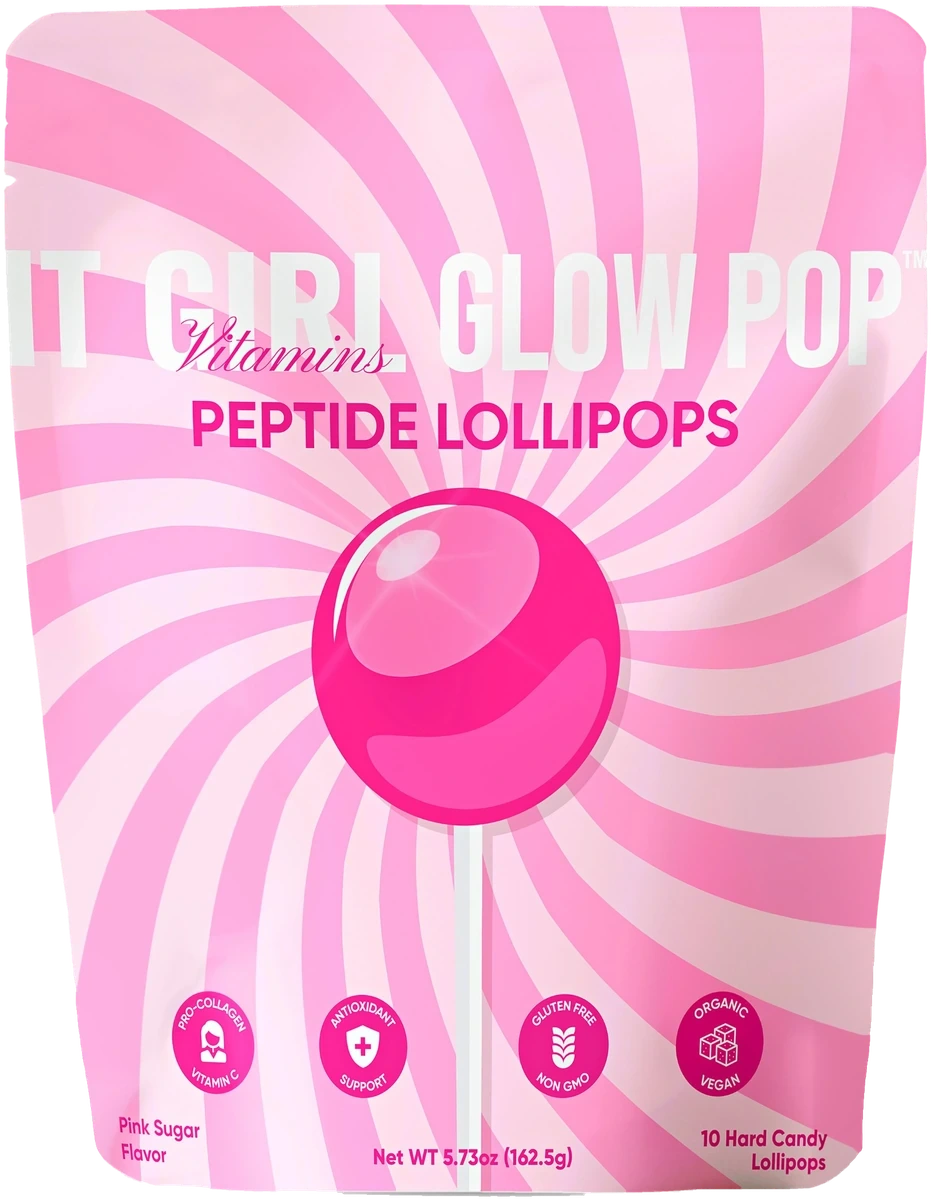
It Girl Skin takes the other route: 10.5 g of peptides and a 5.3 g multi-collagen complex in two gummies a day, with Ceramosides, hyaluronic acid, phytoceramides, L-glutathione, CoQ10 and astaxanthin. Breadth instead of one type. Separately, our vegan Peptide Beauty Pop pairs 7,000 mg of collagen peptides with 500 mg of vitamin C: the pairing that matters most and the one most labels forget.
Whichever you compare, the variable that decides the outcome is not the source. It is whether you take it. Our realistic timeline covers how long that has to go on, and our look at whether beauty supplements work covers whether to start.
Questions people actually ask
Is marine collagen better than bovine collagen?
Neither is better in general; they are different mixes. Marine is almost entirely Type I, the dominant collagen in skin, and usually made at a smaller average peptide size. Bovine supplies Types I and III together, costs less and suits anyone avoiding fish.
Does vegan collagen actually contain collagen?
Usually not. Collagen is an animal protein and plants do not make it, so most products labeled vegan collagen are builder blends: amino acids, vitamin C, silica, sometimes zinc. Biofabricated collagen from engineered yeast or bacteria does exist, but it is uncommon on supplement shelves, so read the panel rather than the front.
What is the difference between collagen and gelatin?
The same protein at different stages of breakdown. Gelatin is partially broken down, so it dissolves in hot liquid and sets to a gel when cold. Collagen peptides are hydrolyzed further into short chains that dissolve in cold liquid and do not gel.
Which collagen type is best for skin?
Type I dominates skin, with Type III alongside it, so beauty formulas are generally built around those two. Type II belongs to cartilage and turns up in joint products instead. A label that names its types is telling you more than one that just says "collagen."
Can I take marine collagen if I have a shellfish allergy?
Marine collagen is made from fish skin and scales, not shellfish, so the allergens are different. Sourcing and shared facilities still vary, so check the allergen statement on the specific product. If you have a fish or shellfish allergy, are pregnant, nursing, taking medication or managing a health condition, check with your doctor before adding a supplement.
If you want to see this on a real panel, ours are published in full.
This article is for general information and is not medical advice. These statements have not been evaluated by the Food and Drug Administration. This product is not intended to diagnose, treat, cure or prevent any disease.