The Gut-Skin Connection: What We Know and What We Don't
An honest look at the gut-skin axis: what's well established, what's still unsettled, what probiotics and fiber really do, and what gets oversold.
Somewhere in the last few years "gut health" stopped being a digestive topic and became a beauty one. It is now normal to see a serum, a powder and a probiotic sold on one idea: fix the gut, fix the face. Some of that is genuinely interesting science. A lot of it is an early field sold with the confidence of a settled one.
This is the calm version: what is established, what is still being worked out, and what your gut unarguably does for your skin whichever way the trendy part resolves.
- Gut and skin get compared because both are barriers: both face the outside world, both are lined with microbes, both have immune tissue built in.
- The "gut-skin axis" is a real area of research: active, interesting and not settled. Anyone telling you otherwise is selling something.
- The uncontroversial part is unglamorous: your gut is how you absorb the nutrients skin is built from.
- Fiber does more for your gut than any supplement, and most people are not getting much of it.
- "Supports gut health" is a legal phrase, not a result; it means an ingredient is involved in something, not that anything will happen to you.
Why gut and skin keep getting mentioned in the same breath
The comparison is not marketing invention. Your gut lining and your skin are the two big surfaces where you meet the outside world, built along similar principles: cells joined tightly together, a covering that keeps most things out, immune cells stationed behind, and a resident population of microbes on top.
Both also do two contradictory jobs at once. Skin keeps water in and irritants out while still letting you sweat and sense the world. The gut lining keeps the contents of your intestine on the correct side of the wall while absorbing nutrients through it. Barriers that selective are a balancing act, which is why so much immune tissue sits along the gut wall. When two organs are that similar, researchers start looking for traffic between them.
What the "gut-skin axis" actually refers to
The term describes proposed routes by which what happens in your gut could influence your skin: immune signaling, since immune cells activated in the gut circulate; metabolites, because gut bacteria fermenting fiber produce short-chain fatty acids that reach the bloodstream; and nutrient availability, the plainest of the three.
Here is the honest state of it. The mechanisms are plausible and partly demonstrated, and associations between gut microbial patterns and various skin conditions have been observed. What is much thinner is the step everybody wants: evidence that deliberately changing your gut reliably changes your skin, in the direction you want, in people. Much of the strongest work is in animals or in dishes, and human studies tend to be small, short, and to use different strains and outcome measures, which makes them hard to compare.
That does not make it nonsense. It makes it early, and "interesting and unfinished" is a more useful thing to know than a confident claim that turns out to be hollow.
None of this means a food or supplement treats a skin condition. A persistent one is a dermatologist's territory. If you are pregnant, nursing, taking medication or managing a health condition, check with your doctor before adding a supplement.
The uncontroversial part: absorption is upstream of everything
Set the trendy question aside and there is a connection nobody argues about. Skin is built from raw materials, and the only way those get in is through your gut. Every ingredient on every beauty supplement label is a claim about absorption first.
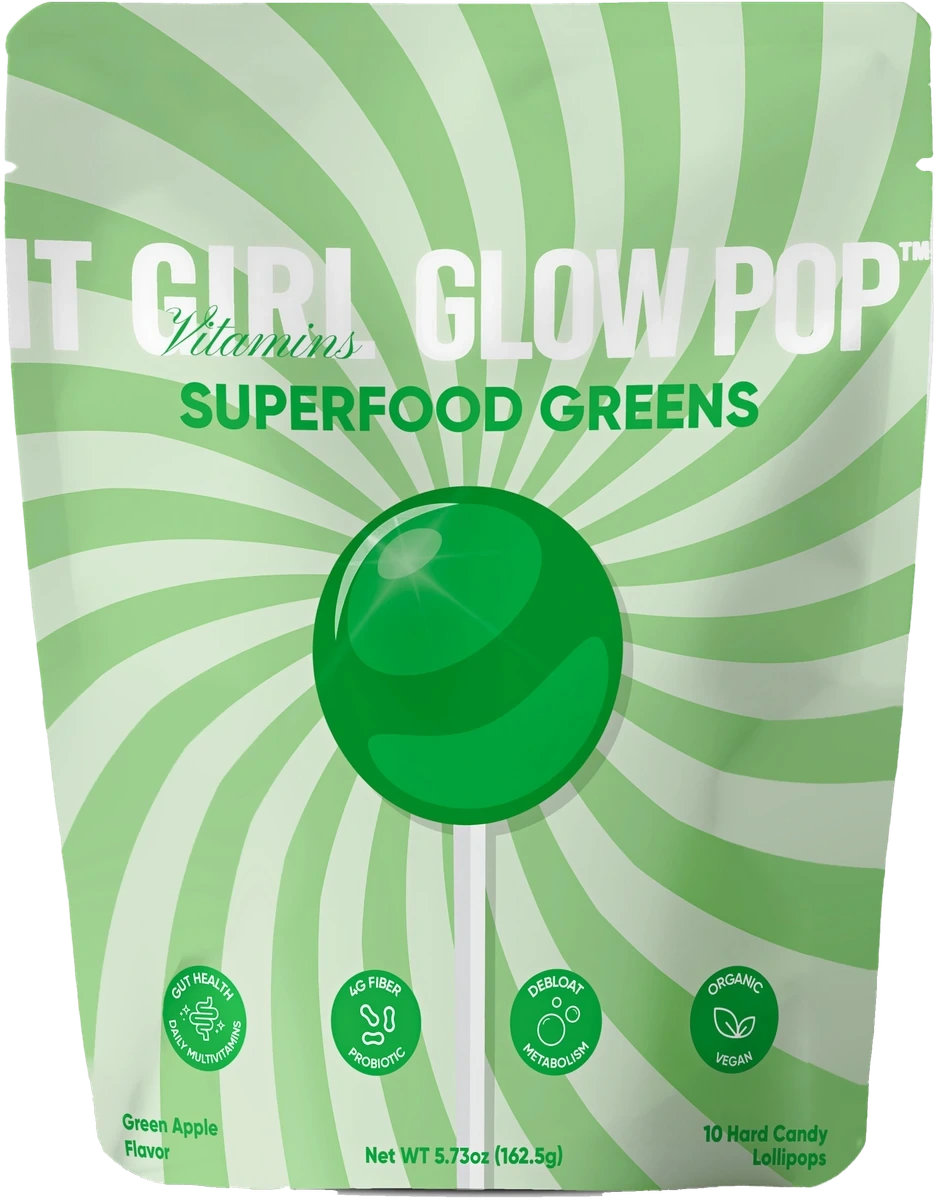
Skin is largely protein, so it needs amino acids. Vitamin C is required by the enzymes that stabilize newly made collagen, which is why collagen formulas so consistently include it, and why the Superfood Greens Pop carries vitamin C and zinc alongside its greens. Zinc is involved in skin repair and turnover, and B vitamins run the energy metabolism of dividing cells.
The absorption step is where things quietly go wrong. B12 needs a functioning stomach and a specific carrier protein to be taken up at all. Fat-soluble vitamins need fat and bile in the same meal. Non-heme iron absorbs better with vitamin C. All of it means the same thing: a nutrient you cannot absorb is a nutrient you did not take, an argument we make from the other direction in our guide to beauty from within.
Fiber is the boring answer that keeps being right
If you only change one thing, change this one. Fiber is the part of plant food you do not digest, which is precisely the point: it arrives in the large intestine intact and becomes food for the bacteria living there. Fermenting it produces short-chain fatty acids, one of which, butyrate, is a preferred fuel for the cells lining your colon. That is about as direct a link between diet and gut lining as nutrition offers.
Soluble and insoluble fiber do different jobs, so variety matters more than volume from one source. And most people eat well under the recommended amount, which means the average person has more to gain from a few more plants than from any capsule.
Probiotics, prebiotics and postbiotics: a plain-English guide
Probiotics, prebiotics and digestive enzymes, defined once
- Probiotics are live microorganisms intended, in adequate amounts, to confer a benefit. Effects are strain-specific, which is why the exact strain matters more than the headline count.
- Prebiotics are food for the microbes already living in you, typically fibers like inulin that you cannot digest but they can. It Girl Snack pairs inulin with five probiotic strains at 10 billion CFU, which is the logic of feeding and seeding in one place.
- Digestive enzymes break food down (protease for protein, lipase for fat, amylase for starch) and your pancreas already makes them. They are genuinely necessary for some medical conditions; for everyone else the case is softer. Gut Glow Up carries all three categories, plus supergreens and B vitamins, two a day.
What "supports gut health" is allowed to mean
Read that phrase as a legal construction rather than a promise. Supplements may describe how an ingredient relates to normal body function; they may not say it treats, prevents or cures anything, and any brand that does is breaking the rules.
So it tells you the ingredient is involved in something plausible. It does not tell you the dose is meaningful, the strain was studied, or that you personally will notice, which is a reason to read the panel underneath the phrase, not to dismiss the category. That habit is the whole of whether beauty supplements actually work.
What gets oversold
- Cleanse and reset language. Your liver and kidneys handle clearance continuously and are not waiting on a product. A formula can supply nutrients and fiber, which is a more modest statement.
- "Leaky gut" as a consumer diagnosis. Intestinal permeability is real, measurable and seriously studied in research settings. The version sold online, where a supplement seals a wall, runs far past the evidence.
- Enormous CFU counts. Bigger numbers are easier to print than to justify.
- Greens powders sold as vegetable replacements. They are useful for nutrients and often tiny on fiber. Worth knowing before you swap, which is why we itemized the category in what is actually in greens supplements.
A daily approach that is deliberately boring
- Food first, and mostly plants. Variety is the active ingredient: different fibers feed different microbes, so many kinds of plant across a week beats the same salad daily.
- Add fiber slowly. Going from very little to a great deal in one weekend is uncomfortable and avoidable. Increase gradually, with water.
- Give it weeks, not days. Nothing here works on a 48-hour timescale, and skin turnover adds its own lag.
- Make it easy to repeat. The format you will actually finish beats the better one you abandon. That is the argument behind our greens for people who hate greens piece, and behind putting Bacillus coagulans in a lollipop at all.
Questions people actually ask
Is the gut-skin connection real?
The gut-skin axis is a real, active area of research built on plausible routes: immune signaling, bacterial metabolites and nutrient absorption. What is well established is that your gut is how you absorb the nutrients skin is made from. What is unresolved is whether deliberately changing your gut reliably changes skin in people, and that evidence is early.
How long does it take for gut changes to show up in skin?
Longer than most people expect, and there is no reliable published timeline. Skin renews itself over weeks, so even a real change upstream takes time to show. A sensible trial is measured in months, and it is worth changing one thing at a time.
Do I need a probiotic if I eat fermented foods?
Not necessarily. Fermented foods contain live microbes, though species and amounts vary between foods and batches. A supplement offers a defined strain at a defined amount, which is its main advantage. Neither replaces fiber, which feeds the microbes you already have.
Are greens powders good for gut health?
They are better described as concentrated nutrients than as gut products. Most contribute very little fiber compared with vegetables, and fiber is the part that feeds your gut bacteria. Some add a probiotic strain or a prebiotic fiber on top. Useful addition, poor substitute.
What does "supports gut health" actually mean on a label?
It is a structure-function claim: the brand is describing how an ingredient relates to normal body function. It is not permitted to mean the product treats or prevents anything, and it is not a statement that you will notice anything. Treat it as a signpost to read the panel.
If you would rather your daily fiber and probiotic arrived as something you look forward to, Gut Glow Up and the Superfood Greens Pop are where ours live.
This article is for general information and is not medical advice. These statements have not been evaluated by the Food and Drug Administration. This product is not intended to diagnose, treat, cure or prevent any disease.