What's Actually In a Greens Supplement?
Grasses, algae, fruit extracts and probiotics: what each part of a greens blend contributes, the proprietary blend problem, and who they really help.
A greens supplement is one of the few things people buy without being able to say what is inside it. The front of the tub says "40 superfoods". The back says "proprietary blend, 8.2 g". Between those two numbers sits the answer to whether it was worth the money, and the label has been arranged, carefully, so that you cannot find it.
Here is what is actually in most greens products, what each part contributes, and how to tell a well-built one from an expensively packaged jar of dried grass.
- Nearly every greens product is four things: leafy greens and grasses, algae, fruit and vegetable extracts, and extras like probiotics and added vitamins.
- A blend declared by total weight tells you almost nothing, because the cheap ingredients usually carry most of that weight.
- "Broken-cell" chlorella matters: human digestion does not open that cell wall, so uncracked, much of it passes through.
- The added vitamins and minerals are the most trustworthy lines on the label, because they are declared by amount.
- Greens supplement vegetables, they do not replace them. A few grams of powder is not a plate of food.
The four things in almost every tub
Leafy greens and cereal grasses
Spinach, kale, broccoli, and the grasses: barley grass and wheatgrass, the young shoots of cereal plants cut before any grain forms. All of it dried and milled. What survives reasonably well is minerals, carotenoids, some vitamin K and chlorophyll, which is why the powder is green and why it tastes like a lawn. What does not survive well is vitamin C, which is why formulas add it back separately.
What is missing by design is volume. Drying strips the water, and water is most of a vegetable. A few grams of dried leaf carries well under a gram of fiber, the honest limit of the entire category.
Algae
Spirulina, chlorella and blue-green algae: the ingredients that make a formula look more exotic than a bag of spinach, and the ones most often described badly. Sections of their own follow.
Fruit and vegetable extracts
Apple, beet, berry powders, aloe vera. Three jobs, and flavor is the first, whatever the marketing says. Grass powder is difficult to swallow and apple is what makes it possible. Beyond that: polyphenols and color.
The extras
Probiotics, digestive enzymes, adaptogens, added vitamins and minerals. The most useful part of the label and the part people skim, because these are declared by amount rather than buried in a blend. If a greens product does something you can point to, there is a decent chance it comes from here.
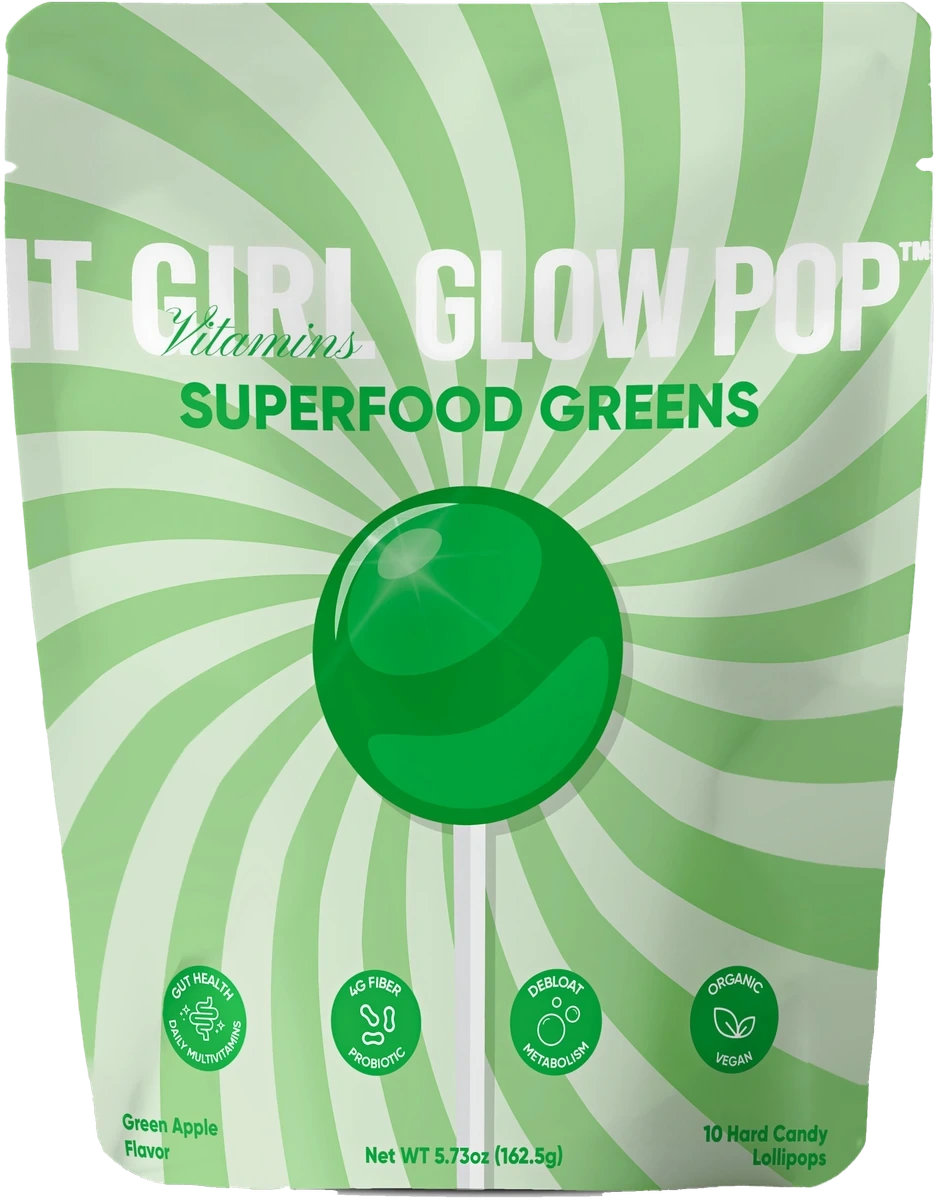
Our own blend reads to exactly that shape: organic spinach, kale, barley grass and wheatgrass, then spirulina, broken-cell chlorella and blue-green algae, then apple and aloe vera, with vitamin C, zinc, B5, B6, B12 and Bacillus coagulans declared separately.
The proprietary blend problem
A proprietary blend lets a brand list ingredients in descending order by weight while declaring only the total. Forty ingredients, 8 g. If the first is 6 g of apple powder and the other thirty-nine share what is left, the label reads identically to one where the split is even. That is the feature, not the bug.
Arithmetic is the defense. Divide blend weight by ingredient count: fifty ingredients in 5 g averages 100 mg each, closer to a garnish than a dose. The industry term is fairy dusting, and it exists because ingredient count sells better than ingredient weight. Dose is where nearly every supplement question gets settled, the argument we make in whether beauty supplements actually work.
Ingredient count is a marketing number. Weight per ingredient is the real one. A short blend declared honestly beats a long blend declared vaguely, every time.
Broken-cell chlorella, and why the cell wall matters
Chlorella is a single-celled freshwater algae built with a tough cellulose cell wall that human digestion does not take apart. Whole chlorella passes through largely intact, which makes the contents of the cell fairly academic.
So processing cracks it, written on labels as broken-cell wall, cracked cell wall or pulverized. It is an extra step that costs money, which is why brands paying for it say so. A label reading only "chlorella" may have been cracked, or may not. It is one of the few genuine specification differences in a category of interchangeable ingredients, which is why our Superfood Greens Pop names it.
Spirulina and blue-green algae, in plain terms
Spirulina is a cyanobacterium grown in alkaline water, harvested and dried. It is unusually high in protein by dry weight, the fact everyone quotes and the one least relevant here, since a serving holds a gram or two. What it brings is phycocyanin, the pigment it is named for, plus iron, B vitamins and carotenoids.
The part worth knowing: spirulina is often sold as a vitamin B12 source, and the B12-like compound in it is largely a pseudo-form human metabolism does not use the way it uses true B12. That matters most to anyone eating plant-based and counting on algae for it. A well-built formula adds B12 separately rather than implying it.
"Blue-green algae" usually means AFA, a wild-harvested lake algae. Sourcing matters here: wild harvests can pick up microcystins from other cyanobacteria nearby, and reputable suppliers test for them.
The line we are not going to blur
Greens supplements supplement vegetables. They do not replace them, and no packaging design changes the arithmetic. A serving is a few grams of dried plant; a portion of vegetables is several hundred grams of water, fiber and chewing. Fiber is what feeds gut bacteria, and that does most of the quiet work in the conversation between your gut and your skin. You cannot get it from a scoop, and certainly not from a lollipop. What greens are good at is narrower and still worth something: a spread of plant micronutrients on a bad week, and a delivery system for things dosed properly.
How to get your greens when you genuinely hate greens
How to read a greens label in 60 seconds
- Find the blend weight, not the ingredient count. One is information, the other decoration.
- Divide it by the number of ingredients. Under 100 mg average, most of that list is there to be read rather than absorbed.
- Read what is declared by amount. Vitamins, minerals and probiotic CFU counts are your real dose lines.
- Check the chlorella. Broken-cell, cracked cell wall, or nothing.
- Check the B12. Added separately is a good sign; implied by spirulina is not.
- Read the sweetener line, and look for heavy metal testing. Greens are plants concentrated on purpose, including whatever was in the soil.
Who greens supplements genuinely help
People who travel, whose produce access is whatever the hotel and the airport offer. People who find vegetables genuinely unpleasant rather than inconvenient. And people whose week goes sideways in the ordinary way, where the plan was three vegetables a day and the reality was a sandwich at a desk. Who they help least: anyone already eating well who wants a shortcut. There is none in the tub.
The probiotic line rewards reading too. Our greens pop uses Bacillus coagulans, a spore-forming strain, and the spore is why it survives a cooked candy and a long shelf life when many strains would not. Which strain, and how many, tells you more than the word "probiotic" alone, as we unpack in what probiotics and prebiotics have to do with your skin. For greens with enzymes and prebiotic fiber, that is Gut Glow Up.
If you are pregnant, nursing, taking medication or managing a health condition, check with your doctor before adding a supplement. Greens can be high in vitamin K, worth raising if you take blood thinners.
Questions people actually ask
Do greens powders replace vegetables?
No, and fiber is the clearest reason why. A serving of greens powder is a few grams of dried plant, while a portion of vegetables is mostly water and fiber by weight. Greens can add a spread of plant micronutrients on a bad week, a real but modest job.
What does broken-cell chlorella mean?
Chlorella has a tough cellulose cell wall that human digestion does not break down, so whole chlorella largely passes through. Broken-cell chlorella has been processed to open that wall first. It is an extra manufacturing step, so brands paying for it generally say so on the label.
Is spirulina a good source of vitamin B12?
Usually not the source people assume. The B12-like compound in spirulina is largely a pseudo-form that human metabolism does not use the way it uses true B12. Anyone eating plant-based should look for B12 declared separately on the Supplement Facts panel.
Are proprietary blends always a bad sign?
Not always, since a genuinely novel formula can be worth protecting. But a blend declared only by total weight means you cannot tell how much of each ingredient you get. The more ingredients crammed into a small total, the less any one is likely contributing.
Do greens supplements do anything for your skin?
The ingredients most often connected to skin are the ones declared by amount, such as vitamin C and zinc, which your body uses in ordinary skin and tissue processes. What the algae and grasses contribute is harder to pin down, and research is ongoing. Think of greens as insurance rather than as a skincare step.
If your obstacle is the shaker rather than the idea, the Superfood Greens Pop puts that blend on a stick, which is a smaller ask on a bad day.
This article is for general information and is not medical advice. These statements have not been evaluated by the Food and Drug Administration. This product is not intended to diagnose, treat, cure or prevent any disease.