Hyaluronic Acid: Taking It vs Putting It On
What hyaluronic acid does, why a humectant can backfire in dry air, what is understood about taking it orally, and whether you need both routes.
Hyaluronic acid is both one of the most used ingredients in skincare and one of the least understood by the people using it. It is in the serum, the sheet mask, the moisturizer, and now in things you swallow. The wording on all of them is suspiciously similar, which is usually a sign the confidence behind it is not.
Here is what is going on in both directions, including the part of the topical story that never reaches the bottle.
- Hyaluronic acid is a molecule your body already makes and keeps, mostly in skin, joints and the eye. It is a humectant: it binds water.
- On skin it works at the surface, and it needs something over it. In dry air, an unsealed humectant can pull water out of your own skin.
- By mouth the picture is promising and unfinished. It is broken down before absorption, and what the fragments do next is still being researched.
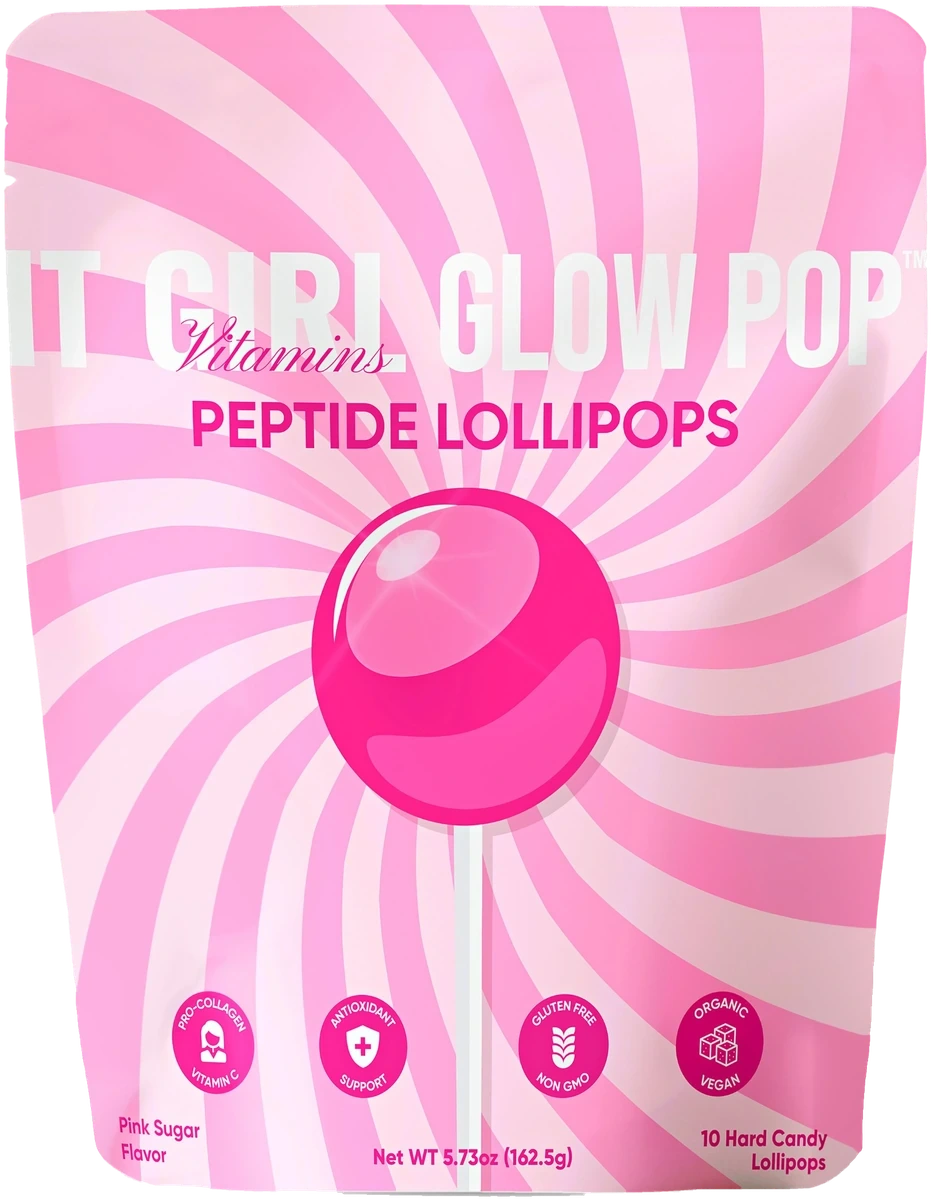
- Our Peptide Beauty Pop carries 500 mg, It Girl Snack 250 mg. There is no agreed effective dose.
What hyaluronic acid is, and where your body already keeps it
Despite the name it is not an acid the way glycolic or salicylic is. It is a long-chain sugar molecule, a glycosaminoglycan, and your body makes it continuously.
Most of it sits in the dermis, woven through the scaffolding between cells, where it holds water and gives tissue its cushion. There is more in the fluid that lubricates joints and the gel that fills the eye. The amount in skin is generally understood to decline with age, which is where marketing runs ahead of the evidence: no supplement has been shown to reverse that.
What a humectant actually does
Three categories worth keeping straight. Humectants bind water and pull it toward themselves; emollients soften by filling between surface cells; occlusives sit on top and slow evaporation.
Hyaluronic acid is squarely a humectant, as is glycerin, which quietly does more of the real work than it gets credit for. The thing to hold onto: a humectant does not create water. It relocates it: from the air, from the product it is in, or from the tissue underneath.
The topical story, including the part nobody prints on the bottle
Applied to skin, it draws water into the upper layers and holds it there, which is why skin looks fuller within minutes. The effect is real, mostly about water in the outermost layer, and temporary. Temporary is not an insult; most of what moisturizer does is temporary.
The part that gets left out is that last phrase, from the tissue underneath. A humectant takes water from wherever it is available. In humid air, that is the air. In a heated apartment in February, on a plane, or in a dry climate, the nearest supply is deeper in your own skin, and with nothing sealing the surface that water evaporates. Which is how a hydrating serum leaves your face tighter than it was.
The fix is dull and reliable: damp skin first, then a cream or balm on top. Same logic as skin hydration from the inside out, where a humectant is a sponge and a sponge needs a lid.
The oral story, told carefully
Start with what is not in dispute. Hyaluronic acid is a large polymer, far too big to be absorbed intact from the gut. Enzymes and gut bacteria break it into smaller fragments, and those are what cross over.
What happens next is where the honest uncertainty begins. One proposed route is that the fragments become raw material wherever the body builds its own. Another is that they act as a signal to skin cells. Neither is settled, and they are not exclusive.
There is a body of human research on oral hyaluronic acid and skin moisture. Much of it is small, a good deal is funded by ingredient suppliers, and methods vary enough to make comparison difficult. Suggestive rather than proven is the fair summary. We will not quote a percentage, because the ones that circulate come from studies too small to carry them, the standard we apply in do beauty supplements actually work.
Uncertain is not the same as ineffective. It means the honest answer is "probably, for some people, by a mechanism still being mapped." If you are pregnant, nursing, taking medication or managing a health condition, check with your doctor before adding a supplement.
Ceramides and glutathione for skin: what each one is doing
Molecular weight, explained without the chemistry
Hyaluronic acid is sold across an enormous size range, and size decides behavior. Think of it as rope length: a very long molecule is too big to go anywhere, so it lies across the surface as a film that slows water loss, while a short one moves into the upper layers, which is where the plumping sensation comes from. Good formulas often blend both.
Oral products generally use low molecular weight material, on the assumption smaller pieces absorb better. Whether very small fragments behave differently once they arrive is an open question; anyone saying it is resolved is overstating.
How much is actually in things
Our Peptide Beauty Pop carries 500 mg per pop, next to 7,000 mg of collagen peptides and 500 mg of vitamin C. It Girl Snack carries 250 mg across a daily pack of seven gummies, and the Electrolyte Hydration Pop includes it with ceramides and vitamin C.
Comparing those against a competitor's is less useful than it looks. Oral labels run from a token sprinkle to several hundred milligrams, there is no agreed dose, and molecular weight is rarely disclosed, so a bigger number is not automatically better. Worth knowing before you pay for a headline figure.
Why vitamin C and ceramides keep turning up next to it
Not coincidence. Vitamin C is a cofactor your body uses in its own collagen synthesis, and collagen is the framework hyaluronic acid sits within, which is part of why collagen products carry both, as we get into in collagen 101.
Ceramides do the opposite job, and that is the point. Hyaluronic acid holds water; ceramides and the lipids around them slow the rate it escapes. Holding and sealing are different problems.
Do you need both routes?
If you are only doing one, do the topical one and seal it: it acts where the tightness is, works the day you use it, and the mechanism is not in question.
Oral is a different bet: longer horizon, less certain mechanism, almost no effort if it rides along with something you already take. Inside and outside do different jobs rather than compete, the broader argument in our guide to beauty from within.
| On your skin | By mouth | |
|---|---|---|
| Where it acts | Surface and upper layers | Systemically, after breakdown |
| How fast | Minutes | Weeks, if at all |
| Evidence | Well established | Suggestive, still researched |
| Main catch | Needs sealing or it backfires | No agreed dose; labels vary |
Questions people actually ask
Does oral hyaluronic acid actually work?
It is an active area of research rather than a closed one. Swallowed hyaluronic acid is broken down before absorption, and how the fragments behave afterwards is still being worked out. It is a reasonable addition to a daily routine, but not a replacement for what you apply.
Is it better to take hyaluronic acid or apply it?
Applying it has the surer and faster effect, because it acts directly on the layer that feels tight. Taking it is a longer, less certain proposition that costs little effort if it is attached to something you already take. The two are complementary rather than competing.
Why does my hyaluronic acid serum make my skin feel drier?
A humectant pulls water from whatever is nearest, and in dry air that can be the deeper layers of your own skin. With nothing sealing the surface, that water evaporates and skin ends up tighter. Applying to damp skin and sealing with a cream usually resolves it.
How much hyaluronic acid should I take a day?
There is no agreed effective dose for oral hyaluronic acid, and labels range from token amounts to several hundred milligrams. Our Peptide Beauty Pop carries 500 mg and It Girl Snack 250 mg per daily serving. Follow the label of whatever you take, and ask your doctor if unsure.
Where does the hyaluronic acid in supplements come from?
Most hyaluronic acid made today comes from bacterial fermentation, which is why it can appear in vegan formulas. Historically it was extracted from animal sources such as rooster combs, and some still is. If it matters to you, check the label.
If you would rather your hyaluronic acid came attached to a habit you keep, that is the thinking behind the Peptide Beauty Pop.
This article is for general information and is not medical advice. These statements have not been evaluated by the Food and Drug Administration. This product is not intended to diagnose, treat, cure or prevent any disease.